
 16 Oct 2026
How to Choose a Fruit and Vegetable Dryer for Your Processing Business
Buying a drying machine is rarely a question of which machine is “best.” The real question is which one fits your product, your harvest volumes and the energy already available on your site. A machine that suits a mango packhouse running at full tilt for six weeks may be a poor match for a grower drying spinach in smaller batches across the year.
Here are the decisions that usually matter most, in the order most buyers face them.
Start with your product and your harvest
Fresh fruit and vegetables are mostly water, and drying is simply the controlled removal of it. But products behave differently. A juicy pineapple ring holds moisture differently from a thin carrot slice, and how you cut the product often matters as much as what it is.
Light, leafy products need particular care. Spinach can shift around in a strong airflow, which is why variable flow regulation for lightweight products is worth asking about.
Before talking to any supplier, write down three things:
- How many tons of fresh produce arrive on your busiest day
- How many weeks that peak lasts
- Which products will share the dryer across the year
Size the dryer by wet load, not dried output
Capacity is quoted as the wet product load per batch. Dryers International’s fixed standing dehydrators range from 1.5 to 8 tons, with the 1.5, 2 and 3 ton next-generation models most widely used. Smaller units are available on request.
Match the heat source to the fuel you already have
This is where running costs are largely decided. Three options are offered:
Hot-water heating
Air is indirectly heated by hot water through a corrosion-resistant heat exchanger. Boilers can burn coal, macadamia nut shells or other bio fuels. According to Dryers International, this is the most widely used system and generally the most cost-effective because fuel is cheap.
Steam heating
If your plant already uses steam, for pasteurization for example, steam heat exchangers make sense. They run at higher temperatures than hot-water exchangers and avoid the cost of a separate hot-water boiler.
Gas-fired heating
These dryers burn LPG or natural gas in direct-fired, low-NOx burners. They suit regions where boiler fuel is hard to obtain and gas is easier to source.
Compare the delivered price and supply reliability of each fuel at your location, not just the headline price per unit.
Look closely at airflow and controls
Uneven drying is a common source of quality problems. Trays nearer the fan may finish early and over-dry, while pockets elsewhere stay damp, which can undermine shelf life. Ask each supplier how they manage airflow. Dryers International offers flow control optimization, and reversible flow options, to promote more uniform drying.
On the control side, the standard automated electronic system supports multiple drying stages, meaning different settings at different points in a batch. An optional PLC (programmable logic controller) adds data logging, on-screen monitoring and remote maintenance over Ethernet, and can run several dryers from one interface.
Fixed or container: think about your site
Fixed standing dryers are built on site, need a level floor and are enclosed in polyurethane or polystyrene panels with chromadek cladding.
A container dehydrator is a converted shipping container with a maximum load of 1.5 tons of wet product (based on mango or pineapple). It is easier to ship and place, and often preferred in remote locations. Its functions and add-on systems match those of the fixed version.
Also allow floor space for loading, staging trolleys and moving product.
Trays, labour and maintenance
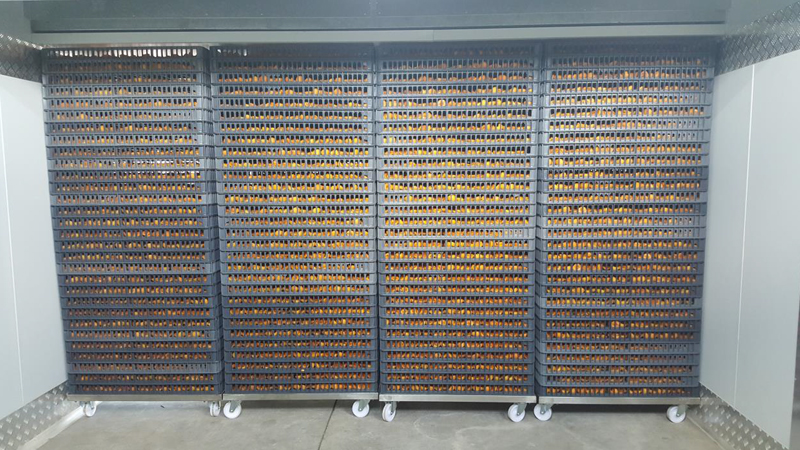
Plastic trays make loading and stacking easier and avoid the strand contamination sometimes seen with open net trays, though net trays are available. Trays sit on corrosion-resistant trolleys. Because loading happens every batch, handling time adds up quickly.
Ask about spare parts availability and what routine servicing looks like.
Count the full running cost
Purchase price is only part of the picture. Add fuel, fan electricity, labour, maintenance and product lost to uneven drying. Offsetting these, dried produce is much lighter, which reduces transport costs.
Making the final decision
Shortlist suppliers who ask about your products, volumes and fuel before suggesting a model. A good fruit drying system is specified around those facts.
Frequently asked questions
-
What size fruit and vegetable dryer do I need?
Work from peak daily fresh intake and the product’s drying time, not your dried output. Divide intake by batch size to see how many batches you need per day.
-
Can one dryer handle both fruit and vegetables?
Generally yes. Dryers International lists mango, pineapple, carrots, onions, spinach, tomato and many others. Lightweight products may need variable flow regulation.
-
Which heating option is cheapest to run?
It’s based on your local fuel supply. Hot water tends to be the most cost-effective as the fuel is relatively cheap, whereas steam is ideal for facilities that produce it anyway.
-
Are commercial dehydrators portable?
Yes, within its 1.5 ton wet-load limit. It offers the same functions as the fixed version and suits remote sites.
-
Can I add capacity later?
Dryers International designs systems so that add-on dryers can be integrated as your business grows.
Talk to the engineers
Send your product list and expected volumes, and we will help you work out the right dryer, heat source and layout.
See our dryersContact the team
Dynamic Dryers International, 186 Voorhamer Street, Unit 5, Silverpark, Silvertondale
(+27) 12 942 8234 | drikus@dryersinternational.com